Sunday, December 31, 2023

Praying the Angelus with Art: An important message

As we close this year, this Flemish Annunciation with its delicate light offers us hope for the light of a new year. That is my prayer, too.

With this gentle image, my weekly Annunciation messages must come to an end. It has lasted ten years: something I never anticipated! But with the release of my book during this 350th anniversary of the apparitions of the Sacred Heart to St. Margaret Mary, I need to direct my activities toward the focus the Lord gave St. Margaret Mary: promoting the nine First Fridays in reparation for Eucharistic coldness, sacrilege, and neglect. Indeed, the more I reflect on it, the more convinced I am that Our Lord asked for this reparation 350 years ago in anticipation of our own time, when an overwhelming percentage of Catholics would neglect Sunday Mass, and receive "unworthy Communions," not out of malice, but out of sheer ignorance. 

I hope in the future to create a series of online videos, and perhaps a parish retreat, using all that I have learned from the many works of art I have shared with you through the years. When that happens, or if I find a new way to share the art of the Annunciation, I will let you know here and on various social media channels, whatever the times may offer.

Thank you for accompanying me week by week, and for praying (and promoting) the Angelus! God bless you!

Anonymous 15th Century Flemish Annunciation
Museu Nacional d'Art de Catalunya

Sunday, December 24, 2023

Praying the Angelus with Art: This Week's Image

Is this Gothic Annunciation from Spain not both splendid and unique? Mary is inside, and yet the room is open to the outside. Her bedroom itself is in and also open to the garden (an enclosed garden, as we can tell by the surrounding walls in the background): Mary is herself the "garden enclosed" where God meets humanity in a wedding that will never end. I chose this image for the 4th Sunday of Advent for that reason.

I love the sharpness of the image: the walls are cleanly stuccoed, while the decoration of the floor tiles is not overdone, allowing the brocaded robes on Mary and Gavriel to really stand out.

Annunciation, Master of Xàtiva
Museu Nacional de Catalunya


Sunday, December 17, 2023

Praying the Angelus with Art: This Week's Image

Here's an unusual concept: An Annunciation depicted within a picture of a bed and curtain. (Notice the curtain rod at the top of the sheet; the entire background is the curtain on which the rose-bush and Annunciation are delicately placed. But the roses should not have thorns!)

Gaspar Homar (1870 – 1955) executed this in watercolor, pen and ink and graphite pencil on paper mounted on a colored cardboard, circa 1900-1905.

Bed and curtain with Annunciation, Gaspar Homar (circa 1900)
Museu Nacional d'Art de Catalunya


Sunday, December 10, 2023

Praying the Angelus with Art: This Week's Image

This image by Josep Bernat Flaugier (1757 – 1813) dates to 1800 and features, rather unusually, two putti looking on. 

Annunciation (Flaugier, 1800)
Museu Nacional d'Art de Catalunya


Sunday, December 3, 2023

Praying the Angelus with Art: This Week's Image

 My community has an exceptionally high firewall that does not permit me to access web pages in ... certain countries. So I had to copy and past the information about the painter of this modern Annunciation from a Facebook page honoring the matriarch of an Italian-American family eatery. I don't know where she got it. (Probably on the other side of the firewall.)

Anyway, I chose this image for today because the abundance of lilies seems to speak of this week's Solemnity of the Immaculate Conception (the patronal feast of and a Holy Day of Obligation in the U.S.).

Ukrainian Theotokos by Alexander Igorevych Okhapkin, born in 1962 in Kirovograd . In 1982 he graduated from Dnipropetrovsk Art College , in 1990 - Kiev Art Institute (studio of Shatalin). He paints icons depicting Our Lady and Jesus in Ukrainian attire. In his works, the traditional techniques of ancient icon painting and modern execution are synthesized. Art critics call his work "religious poetry in paints."

Annunciation, Alexander Okhapkin

Sunday, November 26, 2023

Praying the Angelus with Art: This Week's Image

All I have been able to find out about this Annunciation (so far!) is that it is possibly of Dutch origin, circa 1520, and is housed in the Berlin Gemäldegalerie.

Annunciation, 1520
Gemäldegalerie, Berlin


Sunday, November 19, 2023

Praying the Angelus with Art: This Week's Image

I thought The Angelus Project had featured all of El Greco's Annunciations already! I was wrong. This gem, dated 1577-1580, was hiding in the Museu Nacional d'Art de Catalunya.

Annunciation, El Greco c 1577-1580
Museu Nacional d'Art de Catalunya


Sunday, November 12, 2023

Praying the Angelus with Art: This Week's Image

A delicate late 15th century Annunciation by Piero di Pollaiolo is full of architectural details.

Annunciation (1470) by Piero di Pollaiolo
Gemäldegalerie of Berlin
Image from Wikimedia Commons

Sunday, November 5, 2023

Praying the Angelus with Art: This Week's Image

From the Museu Nacional d'Art de Catalunya comes this amazing Gothic Annunciation by an unknown artist from 15th century Valencia, Spain.

Annunciation, 15 century Valencian
Museu Nacional d'Art de Catalunya


Sunday, October 29, 2023

Praying the Angelus with Art: This Week's Image

 The Museu Nacional d'Art de Catalunya has this amazing 12th century fresco, transferred from the actual walls of a church nave (body) to canvas. Above one of the arches we see the Annunciation. It could be that the upper layer of images are from the infancy narratives, while the arches may feature the passion. (That is just a conjecture on my part, since the full image available to me shows a Nativity to the left of the Annunciation.)

At first I had my doubts about this being an Annunciation, and then I saw that Mary what was working on. Spinning thread into yarn is a clear sign of Our Lady of the Annunciation!

Annunciation from frescoes of the parish church of Sant Pere de Sorpe (Alt Àneu, Pallars Sobirà)


Some of the nave frescoes of the parish church of Sant Pere de Sorpe (Alt Àneu, Pallars Sobirà)
Museu Nacional d'Art de Catalunya


Sunday, October 22, 2023

Praying the Angelus with Art: This Week's Image

Annunciation by Alonso Gallego (1457-1548). It would be interesting to see this altarpiece in its original setting ( the parish church of San Hipólito, in the town of Támara, Palencia, Spain), to understand why the torsos of Mary and Gabriel are so elongated and Gabriel's face, in particular, seems foreshortened. 

Annunciation, 1530-1537
Museu Nacional d'Art de Catalunya


Praying the Angelus with Art: This Week's Image

From the early 1300's comes this carved section of a Spanish Gothic altarpiece, the work of noted sculptor Jaume Cascalls.

Annunciation in alabaster by Jaume Cascalls (altarpiece fragment)
Permanent loan from the Reial Acadèmia de Bones Lletres de Barcelona
to the Museu Provincial d'Antiguitats, 1879
Museu Nacional d'Art de Catalunya


Sunday, October 15, 2023

Praying the Angelus with Art: This Week's Image

Another Annunciation by Veronese this week! Here again we see the master's architectural setting telling part of the story. I especially like the way the light of the Holy Spirit is treated!

Read more about the origins of this image and the recent restoration at savevenice.org

Annunciation, Veronese (1578)
Venice, Galleria dell'Accademia


Sunday, October 8, 2023

Praying the Angelus with Art: This Week's Image

The Episcopal Church of St. Paul's Within the Walls in Rome features this 1888 Annunciation in mosaic, designed by Pre-Raphaelite artist Edward Burne-Jones. 


Annunciation
St Paul's Within the Walls, Rome

Greater detail, and an explanation from the church website:

On the face of the first arch, in front of the apse, is a representation of the Annunciation based on an early legend. We see Mary in the desert outside the town walls, drawing water from a spring. As she turns homeward, the angel greets her. Burne-Jones has chosen to represent this as happening against the reddening evening sky, the time of the Angelus. In the lower left-hand corner, we see a pelican, in medieval times a symbol of Christ, for according to popular belief it customarily tore open its breast with its beak to feed its hungry young. Under this scene is written the greeting of Gabriel: “Hail, thou that art highly favored, the Lord is with thee” (Luke 1:28) and Mary’s answer “Behold the handmaiden of the Lord; be it unto me according to Thy word.” (Luke 1:38)

Sunday, October 1, 2023

Praying the Angelus with Art: This Week's Image

We're moving back to Spain this week for a late 14th (or maybe cusp of the 15th) century predella (bottom row of an altarpiece. The Annunciation and Crucifixion are the central panels, flanked on the left by St. John the Baptist and on the right by St. Catherine of Alexandria. Francesc Comes was a significant Majorcan artist and painter to the King of Aragon. (One of Comes' works in the Isabella Stewart Gardiner Museum is thought to feature a portrait of the king.)

Annunciation detail
Francesc Comes predella (Francesc Cambó Bequest, 1949)

Here is the predella in full:

Predella, Francesc Comes
Francesc Cambó Bequest, 1949


Sunday, September 17, 2023

Praying the Angelus with Art: This Week's Image

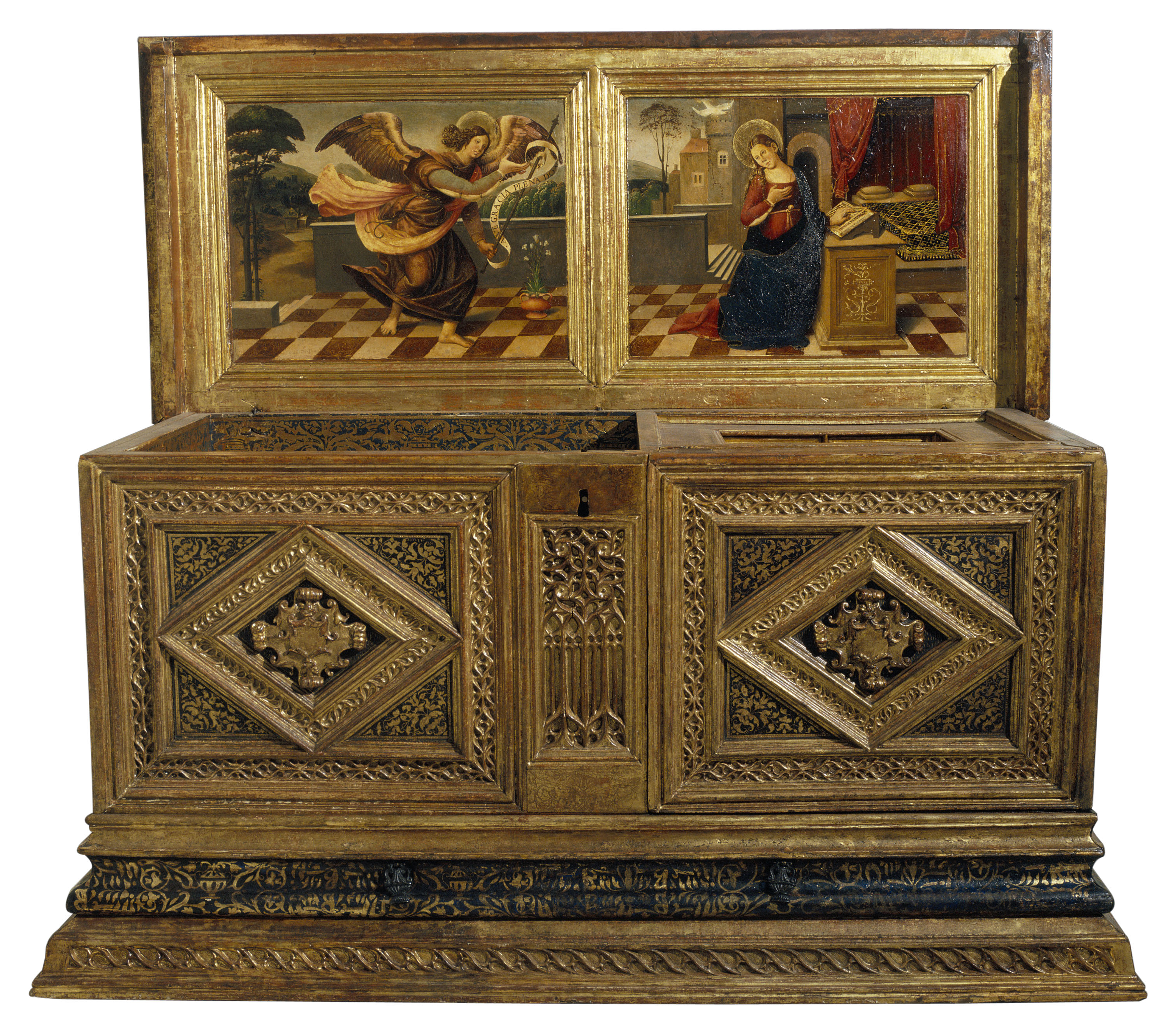
Who was the bride in 16th century Catalonia who put her fine linens into this walnut chest? Did she choose the image of the Annunciation, or was it the giver's idea? Who made the original commission? The image raises so many questions! And only one answer has come to us: there was a woman in Spain who had this lovely image to inspire her life every time she opened the lid on what, without that art, might have been just another piece of furniture. What would she say "yes" to that day?

Bride's chest with Annunciation
Museu Nacional d'Art de Catalunya


Sunday, September 10, 2023

Praying the Angelus with Art: This Week's Image

Detail from Book of Hours

A medieval Book of Hours was an all-purpose devotional: it featured morning and evening prayers, psalms, and popular devotions that were deeply rooted in biblical piety. One of those devotions was the "Hours of the Cross," a way of matching the times of the day with the events of Good Friday. Today's Annunciation comes from the pages of an early 14th century Book of Hours prepared in England for a French user with a Dominican spirituality. Christ's "Hours" (we would call them "stations" of the Cross) are matched with events in Mary's life, according to the time of day they were thought to have happened: the scourging of the pillar with Pentecost (9:00 a.m.); the nailing to the cross with the Annunciation (close to noon, though I don't know of any tradition indicating the time of day of the Annunciation!).

This manuscript is in the collection of the Huntington Library. I thought it fitting to coincide with this week's Feast of the Exaltation of the Holy Cross (September 14) and memorial of Our Lady of Sorrows September 15).


Here is the image in its two-page context:

Henry E. Huntington Library and Art Gallery
Manuscript EL 9 H 17

Sunday, September 3, 2023

Praying the Angelus with Art: This Week's Image

 I heard the 20th century calling out plaintively, "I have some Annunciations to offer, too!" And it true: look at this lovely porcelain vase from the very first years of the 20th century. It was a collaborative effort by Barcelona artists Antoni Serra (1869-1932), a noted ceramic artist, and Josep Pey (1875-1956).

Art Nouveau Annunciation in porcelain


Sunday, August 27, 2023

Praying the Angelus with Art: This Week's Image

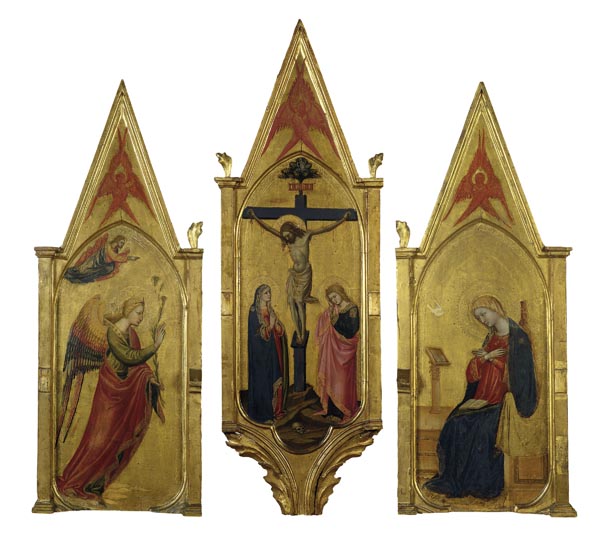
Here is a splendid 15th century Annunciation from a Florentine triptych by Bicci di Lorenzo, now in the Museu Nacional d'Art de Catalunya (on permanent loan from the  Thyssen-Bornemisza Collection). Notice the seraphim (fiery angels) in the peaks above each image. 

The centrality of the Crucifixion reminds us of the centrality of the Cross in the "collect" of the Angelus prayer:

Pour forth, we beseech thee, O Lord, thy grace into our hearts, 
that we to whom the Incarnation of Christ thy Son was made known by the message of an angel may, by his Passion and Cross, be brought to the glory of his Resurrection,
Through the same Christ our Lord. Amen.

Triptych by Bicci di Lorenzo
Thyssen-Bornemisza Collection


About the Angelus Project

We rightly admire Muslim neighbors and co-workers who put everything on hold five times a day in answer to the "call to prayer." But Christians have a call to prayer, too! It is the Angelus. Morning, noon and evening we are invited to pause and reaffirm our faith in the Incarnation: The Word was made flesh and dwelt among us (Jn. 1:14), because "God so loved the world that he sent his only Son" (Jn. 3:16).
The Angelus Project is a personal project of Sister Anne Flanagan, FSP, a Daughter of St Paul. Find out more about the media ministry of the Daughters of St Paul at DaughtersofStPaul.com.

blogspot stats